Tunnel (Élément)
Ce type d'élément est utilisé pour modifier le calcul du bruit des sources linéaires (routes et rail) situées à l'intérieur de l'élément tunnel entré :- Les sections de la source linéaire situées à l'intérieur de l'élément tunnel ne sont pas prises en compte dans le calcul du bruit (son direct).
- Au lieu de cela, des sources de substitution sont générées dans les portails du tunnel pour chaque source linéaire contenue.
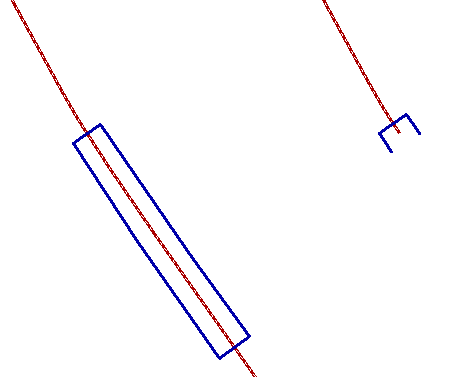
Pour modéliser un tunnel, la source linéaire est entourée par le polygone de l'élément tunnel comme suit:
- On entre un polygone fermé le long du tube du tunnel et des portails du tunnel. Le polygone définit la hauteur, la largeur et la longueur du tunnel (voir figure de gauche).
- Si un portail de tunnel d'un long tunnel (longueur > 1.5 km) est modélisé par l'élément tunnel, le polygone peut être laissé ouvert (voir la figure de droite). [Dans cette figure, notez que les parois de l'élément tunnel ont été introduites de manière à être plus longues que la partie de la source introduite dans le tunnel: cela garantit que cette partie source est interprétée par le programme comme étant à l'intérieur du tunnel.]
Le polygone peut également être laissé ouvert s'il modélise un portail de tunnel et que la longueur est explicitement définie dans les attributs de l'élément tunnel.
| ||
|
L'émission du portail du tunnel et sa directivité sont automatiquement déterminées et prises en compte dans le calcul du bruit. À cette fin, l'émission du segment de source linéaire le plus proche du portail à l'intérieur du tunnel est utilisée pour calculer l'émission du portail.
| ❑ | Indications:
|
Exemples
| input (source- and tunnel-polygon) | number of portals | comments |
Example A1  | 1 | Note that the source intersects the tunnel polygon (so that a portal is implicitly defined at that intersection), but the source does not exit the "inside" of the drawn portion of the tunnel at the other side (note that any portion of the source that is outside the tunnel polygon will be effectively "seen" from the outside of the tunnel, and will thus contribute to receiver-immissions). In this case of an open tunnel-polygon, if you use "auto" for the tunnel's length parameter, then a "very long" tunnel (>1.5 Km) is assumed. |
Example B1  | 2 | If you use "auto" for the tunnel's length parameter, the program automatically estimates the length between the portals. Note that, if the source-element is not floating, then the portion of it that is inside the tunnel defines the height of the terrain surface: if this is unwanted, consider (1) making the source floating or (2) use the approach illustrated in Example B2. |
Example B2  | 2 | This example is like the previous one, but two source elements are used instead of a single one. Note that they just intersect the tunnel. If the emissions and all geometries are otherwise identical, this model is equivalent to the previous example. |
Example B3  | 2 | From an emission perspective, if for both of the here involved tunnel-elements, the explicitly specified length (in their properties) corresponds to the length of the tunnel in the previous example, then, this example is equivalent to the previous one. (There is no equivalence from other perspectives; in particular, tunnel-elements also work as obstacles and as reflectors.) |
Voir aussi: