Tunnel (Element)
Mit diesem Elementtyp wird die Lärmberechnung von Linienquellen (Strassen und Schiene), die sich innerhalb des eingegebenen Tunelelementes befinden, modifiziert:- Die Abschnitte der Linienquelle, welche sich innerhalb des Tunnelelementes befinden werden bei der Lärmberechnung (Direktschall) nicht berücksichtigt.
- Stattdessen werden bei den Tunnelportalen Ersatzquellen für jede enthaltene Linienquelle generiert.
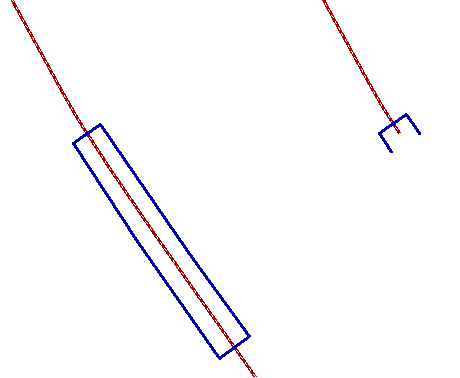
Für die Modellierung eines Tunnels wird die Linienquelle mit dem Tunnelement-Polygon wie folgt umschlossen:
- Entlang der Tunnelröhre und der Tunnelportale wird ein geschlossenes Polygon eingegeben. Damit ist die Höhe, Breite und Länge des Tunnels mit dem Polygon definiert (siehe Abbildung Links).
- Wird ein Tunnelportal eines langen Tunnels (Länge > 1.5km) von einem Tunnelelement modelliert, kann das Polygon offen gelassen werden (siehe Abbildung Rechts). [In dieser Abbildung ist zu beachten, dass die Wände des Tunnelelements so eingegeben wurden, dass sie länger als der in den Tunnel eingegebene Teil der Quelle sind: Dadurch wird sichergestellt, dass dieser Quellteil vom Programm als innerhalb des Tunnels liegend interpretiert wird.]
Das Polygon kann auch offen gelassen werden, wenn es ein Tunnelportal modelliert und die Tunnellänge explizit in den Attributen des Tunnelelements definiert ist.
| ||
|
Die Tunnelportal-Emission und deren Direktivität wird automatisch ermittelt und in der Lärmberechnung berücksichtigt. Dazu wird die Emission des zum Portal nächsten Linienquellen-Segments innerhalb des Tunnels für die Berechnung der Portalemission verwendet.
| ❑ | Hinweise:
|
Beispiele
| input (source- and tunnel-polygon) | number of portals | comments |
Example A1  | 1 | Note that the source intersects the tunnel polygon (so that a portal is implicitly defined at that intersection), but the source does not exit the "inside" of the drawn portion of the tunnel at the other side (note that any portion of the source that is outside the tunnel polygon will be effectively "seen" from the outside of the tunnel, and will thus contribute to receiver-immissions). In this case of an open tunnel-polygon, if you use "auto" for the tunnel's length parameter, then a "very long" tunnel (>1.5 Km) is assumed. |
Example B1  | 2 | If you use "auto" for the tunnel's length parameter, the program automatically estimates the length between the portals. Note that, if the source-element is not floating, then the portion of it that is inside the tunnel defines the height of the terrain surface: if this is unwanted, consider (1) making the source floating or (2) use the approach illustrated in Example B2. |
Example B2  | 2 | This example is like the previous one, but two source elements are used instead of a single one. Note that they just intersect the tunnel. If the emissions and all geometries are otherwise identical, this model is equivalent to the previous example. |
Example B3  | 2 | From an emission perspective, if for both of the here involved tunnel-elements, the explicitly specified length (in their properties) corresponds to the length of the tunnel in the previous example, then, this example is equivalent to the previous one. (There is no equivalence from other perspectives; in particular, tunnel-elements also work as obstacles and as reflectors.) |
Siehe auch: